 By
By 
Renters, apartment dwellers, and anyone who’s had a landlord glare at them over “minor” wall damage will know this struggle well. You want curtains — real curtains that block light, add warmth, and make a space feel finished — but you need to know how to hang curtains without drilling so you don’t have to patch holes later.
The good news: you can absolutely hang curtains without drilling, and some of the no-drill methods are surprisingly sturdy. Command hooks, tension rods, adhesive curtain rod brackets, and magnetic rods are the most reliable options — each suited to different window sizes, curtain weights, and rental situations.
Here’s how to do it properly for each method.
Method 1 — Command Hooks (Most Versatile)
Command hooks are the go-to for most renters because they hold surprisingly well, remove cleanly, and come in sizes rated for different weights.
What you need:
- Large Command hooks (the “jumbo” or “picture hanging” versions for heavier curtains)
- A curtain rod or wooden dowel
- Your curtains
Steps:
- Clean the wall surface with rubbing alcohol and let it dry completely — this is what makes Command strips actually hold
- Mark where you want the rod to sit (typically 4–6 inches above the window frame and 6–12 inches wider on each side)
- Press the Command hook firmly against the wall and hold for 30 seconds
- Wait the full 1 hour before hanging anything — Command strips need cure time
- Rest the curtain rod across the hooks
Weight limit: Standard Command hooks hold up to 7.5 lbs. Use the “large” or “picture hanging” strips for heavier blackout curtains.
Best for: Apartments, lightweight to medium-weight curtains, quick installation.
Method 2 — Tension Rods (Zero Damage, Inside the Frame)
Tension rods require no tools, no adhesive, and no damage whatsoever. They work by pressing against opposite sides of a window frame using internal spring tension.
Steps:
- Measure the inside width of your window frame
- Buy a tension rod that fits your measurement range
- Thread your curtains onto the rod
- Extend the rod slightly wider than the window, then press it into the frame
- Adjust until it holds firmly
Tips:
- Use rubber caps on the rod ends to prevent slipping
- Don’t hang very heavy curtains on tension rods — they’re best for lightweight sheers or café curtains
- For extra stability, wrap the rod ends in rubber bands before inserting
Best for: Kitchens, bathrooms, café-style curtains, lightweight panels.
Method 3 — Adhesive Curtain Rod Brackets
These look and work like regular curtain rod brackets — but attach with heavy-duty adhesive rather than screws.
What you need:
- Adhesive curtain rod brackets (sold specifically for this purpose)
- Standard curtain rod
- Curtains
Steps:
- Clean and dry the wall surface where the brackets will go
- Mark the bracket positions — use a level to ensure they’re even
- Peel the adhesive backing and press each bracket firmly for 60 seconds
- Wait 24–72 hours before hanging the rod (this is critical — rushing it causes failure)
- Slide your curtain rod into the brackets and hang curtains
Weight limit: Quality adhesive brackets can hold 15–30 lbs — enough for most standard curtains. Check the product specs for your specific curtain weight.
Best for: Any room where you want the look of real curtain hardware, medium-weight curtains.
Method 4 — Magnetic Curtain Rods
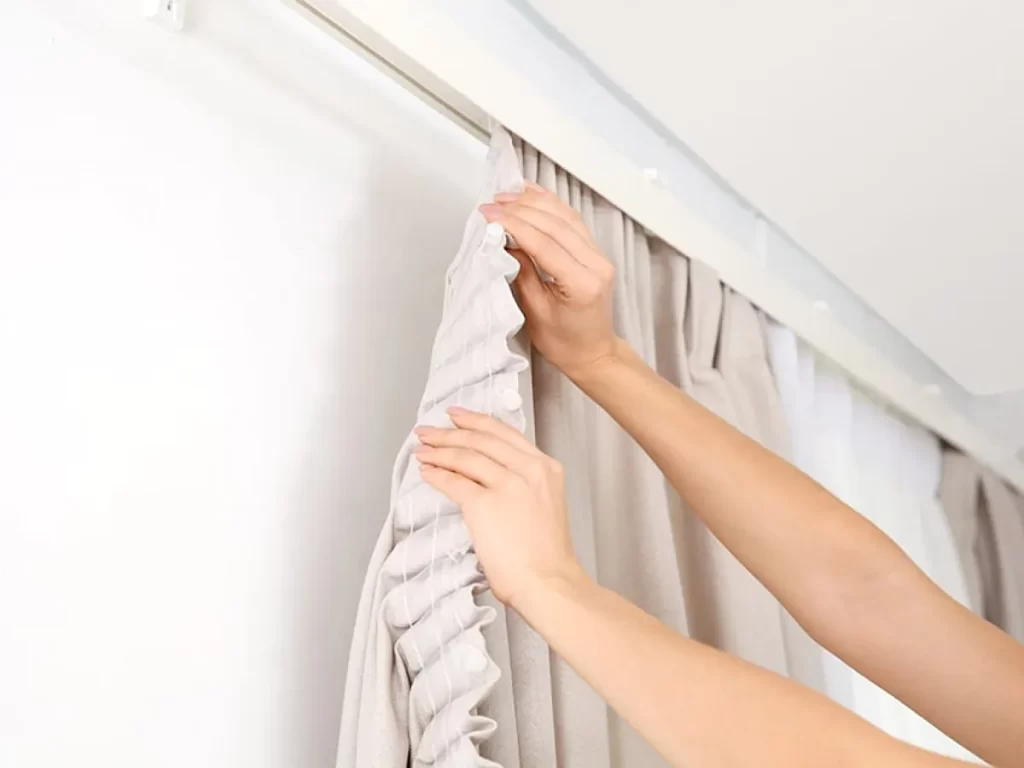
If your window frame or door frame is metal (common in many apartments), magnetic curtain rods attach directly to the metal surface — no adhesive or drilling required.
Steps:
- Thread curtains onto the magnetic rod
- Hold the rod at your desired height and press the magnetic ends to the metal frame
- Done — the magnets hold the rod in place
Best for: Metal window frames, sliding door frames, steel doors.
Method 5 — Over-the-Door and Ceiling-Mounted Options
For room dividers or windows near the ceiling:
- Over-door curtain rods — hook over the top of a door frame; no adhesive needed
- Ceiling track systems — some use adhesive ceiling tracks that hold room divider curtains without touching the walls at all
Choosing the Right Method
| Method | Damage | Weight Capacity | Best Curtain Type |
| Command hooks | Zero (removable) | Up to 15 lbs | Light to medium |
| Tension rod | Zero | Up to 20 lbs | Lightweight, sheers |
| Adhesive brackets | Zero (if removed carefully) | Up to 30 lbs | Medium to heavy |
| Magnetic rod | Zero | Up to 10 lbs | Light panels |
Tips for Success with Any Method
- Always clean the wall first — adhesive fails on dusty, oily, or painted surfaces that haven’t been prepped
- Give adhesive products time to cure — this is where most people fail; 24 hours minimum before adding weight
- Use a level — crooked curtains are very obvious and very easy to avoid with a $5 bubble level
- Hang curtains high and wide — regardless of method, hanging rods close to the ceiling and wider than the window makes rooms look larger and more polished
Bottom Line
No drill? No problem. Tension rods are perfect for inside-frame hanging with zero commitment. Command hooks and adhesive brackets handle real curtain rods and heavier panels. The key to making any of these methods work is surface prep and patience — clean the wall, let adhesive cure fully, and don’t rush the process. Your curtains will look just as good as if they were drilled in.